
Women's Fertility Treatments Ballarat
The team at Ballarat IVF Fertility Group are here to support your fertility journey with personalised care and a patient-focused approach.

Ovulation Induction (OI)
Infrequent ovulation is the most common cause of not getting pregnant. We are experts in providing Ovulation Induction services.
We provide face to face Ovulation Induction, or Ovulation Induction Online through our world first AI program, OVUNET .
Ovulation induction is straight forward and affordable.

Ovulation induction involves:
- Registering with OVUNET or
- Having a Specialist consultation, which can be through telemedicine
- Taking letrozole to stimulate your ovaries
- Having an Ultrasound to assess your response
- Support and advice from your Fertility Nurse or OVUNET
- Testing your urine for an LH surge
- Having a trigger injection.
- Trying to conceive naturally.
Success rates:
Based on our own results, after 4 ovulation induction cycles, 33% of women will achieve a pregnancy, and 26% achieve a live birth.
Risk of ovulation induction:
Multiple birth. At Ballarat IVF 2-3% of Ovulation induction pregnancies are twins. If your ovaries have more than 2 follicles, we will ask you not to try to conceive in that cycle.
Intrauterine Insemination (IUI) & Donor Insemination (DI)
This treatment involves the woman undertaking an Ovulation induction treatment cycle, then placing sperm into the uterine cavity at the time of ovulation.
Sperm may be from a woman’s male partner, or from a donor
Sperm is specially prepared by our IVF Scientists to select out the most motile sperm from the semen sample. This process takes 3 to 4 hours.
The IUI / Di procedure is performed in a similar way to a pap smear, without the need for anaesthetic.
In Vitro Fertilisation (IVF)
For this treatment, eggs are collected from the woman, and combined with prepared sperm from a man in a micro drop of special nutrient media and held in an incubator.
Sperm naturally fertilise the egg. Embryo development is then observed by our scientists, and an embryo is transferred back to the woman 5 days later.
There are a number of steps to follow during IVF treatment:
- Fertility Specialist Consultation – can be via Telehealth
- Pre-Treatment Tests and Preparation
- Fertility Specialist prescribes your personal treatment regimen
- You give yourself FSH injections and some other medications
- Ultrasound to monitor your response and Follicle Growth
- You give yourself a trigger injection to mature the eggs on advice from your fertility nurse
- Semen Collection or Donor Sperm preparation
- Egg collection (a day case procedure under sedation anaesthesia)
- Insemination, Fertilisation and Embryo Culture
- Embryo Transfer (ET) (carefully performed under Ultrasound guidance)
- Embryo Freezing (of additional embryos)
- Pregnancy Testing
Intra-Cytoplasmic Sperm Injection (ICSI)
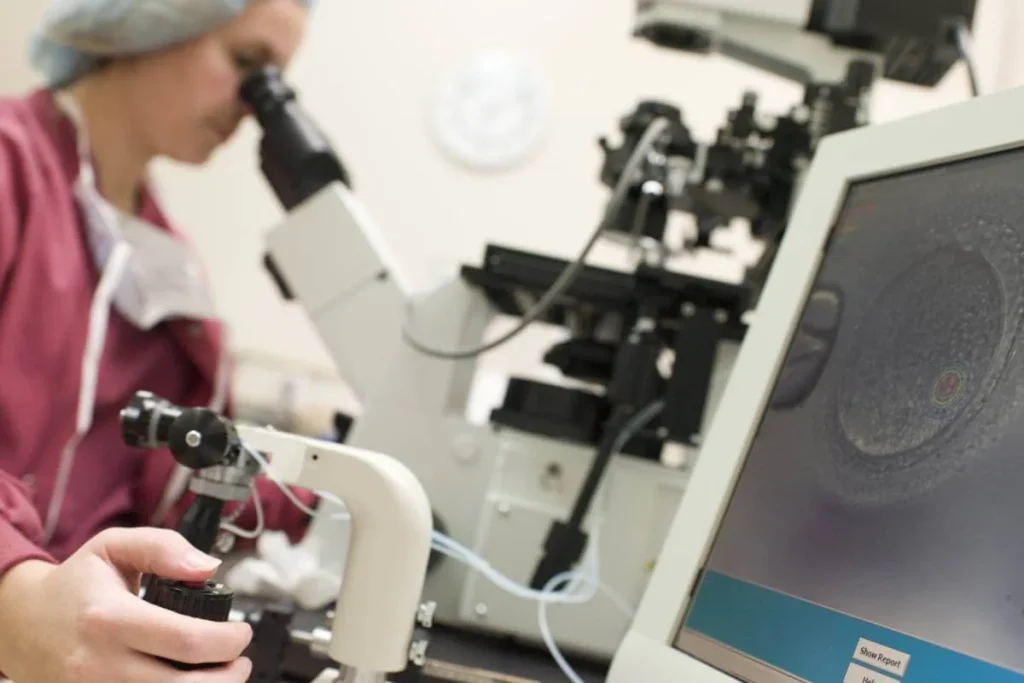
ICSI treatment is a method of sperm micro-injection where a single sperm is injected into an egg.
It may used for couples who…
- have not been able to achieve fertilisation using routine IVF methods
- have semen test results that show that routine IVF is unlikely to give satisfactory results
- have had a vasectomy or reversal,
- have absent or blocked vas deferens (the tube that carries the sperm from the testicles)
DuoStim Treatment
What is DuoStim?
How does this happen?
Who needs DuoStim?
Women who don’t produce many eggs from their first egg collection will benefit from DuoStim. DuoStim gives the woman the opportunity to go straight back into a treatment plan, avoiding unnecessary delays, especially in older women.
Women who are planning egg freezing may wish to store up to 20 eggs. By undertaking a milder stimulation, and using DuoStim, the woman can store a high number of eggs without risking Ovarian Hyperstimulation Syndrome.
What are the advantages?
The main advantage is the ability to collect a higher number of eggs within a short space of time. This is especially of benefit for women who produce low egg numbers during IVF Stimulation. In many of these women, time is critical.
Duostim avoids what can be excessive delays in between treatment cycles.
At Ballarat IVF, there are significant financial benefits with having a Duostim treatment cycle, compared to two separate IVF stimulation cycles.
What are the disadvantages?
Having two stimulation cycles in a short space of time can be emotionally draining.
There is a small additional risk of infection with a Duostim treatment cycle, and it is not possible to have a fresh embryo transfer with a Duostim cycle.
Whilst the cost of a Duostim cycle is less than two separate cycles, it is more expensive than a single IVF cycle.
What about Egg quality?
Based on Ballarat IVF Experience, the quality of egg collected in the first and second part of a Duostim cycle are the same, with a trend to higher quality eggs being collected in the second part. This is reflected in a small, but not significant increase in pregnancy rates and embryo scores in embryos formed from eggs from ‘second part Duostim’.
On average, about two more eggs are collected from the second part of the Duostim cycle compared with the first.
Do I have a choice?
Yes , based on your discussion with your specialist you may choose a Duostim cycle from the beginningof your treatment cycle.
DuoStim may be suggested by your fertility nurse after your egg collection. The final decision whether to go ahead with this will be made by your Specialist after discussion with you.
There is no compulsion to have a DuoStim treatment cycle. Each woman needs to consider the options, and make a final decision with their Ballarat IVF Fertility Group Specialist.